Magicpin is a multi-service ecosystem that serves a diverse set of user needs across food delivery, dining, vouchers, and shopping. Search is a critical entry point, but the existing experience was optimized for known-item queries rather than intent-driven discovery. This case study explores how we redesigned Magicpin’s search experience to prioritize user intent over raw queries, reduce cognitive load, and improve business outcomes through measurable, experiment-driven decisions.
Timeline
22 Days
Live On
Mobile App
🔍
Users get lost in multi-category offerings
Search results mix restaurants, dishes, brands, and offers in one list. Instead of helping users narrow down their intent, the experience asks them to mentally filter irrelevant options, increasing effort at the very moment they want clarity.
🧠
High cognitive load
Without prioritizing results based on user intent, search places unnecessary mental effort on users, delaying decisions and increasing confusion.
📉
Confusion leads to drop-off
When users are unsure which result matches their intent, they hesitate, tap back, or abandon the search altogether. This confusion disrupts discovery and directly impacts conversion.
📢
Promoted listings are ranked above relevant results.
Search prioritises funded results over the most relevant outcome, forcing users to scroll past unrelated or secondary options to reach what they are actually looking for.
Magicpin's POV
1. Improve Search-to-Conversion Rate 2. Reduce search abandonment 3. Enable Cross-Category Discovery 4. Balance Discovery with Revenue
User's POV
1. Search quickly without typing whole words 2. See relevant, trustworthy suggestions immediately 3. Explore options within a chosen category 4. Not switch to other apps to explore
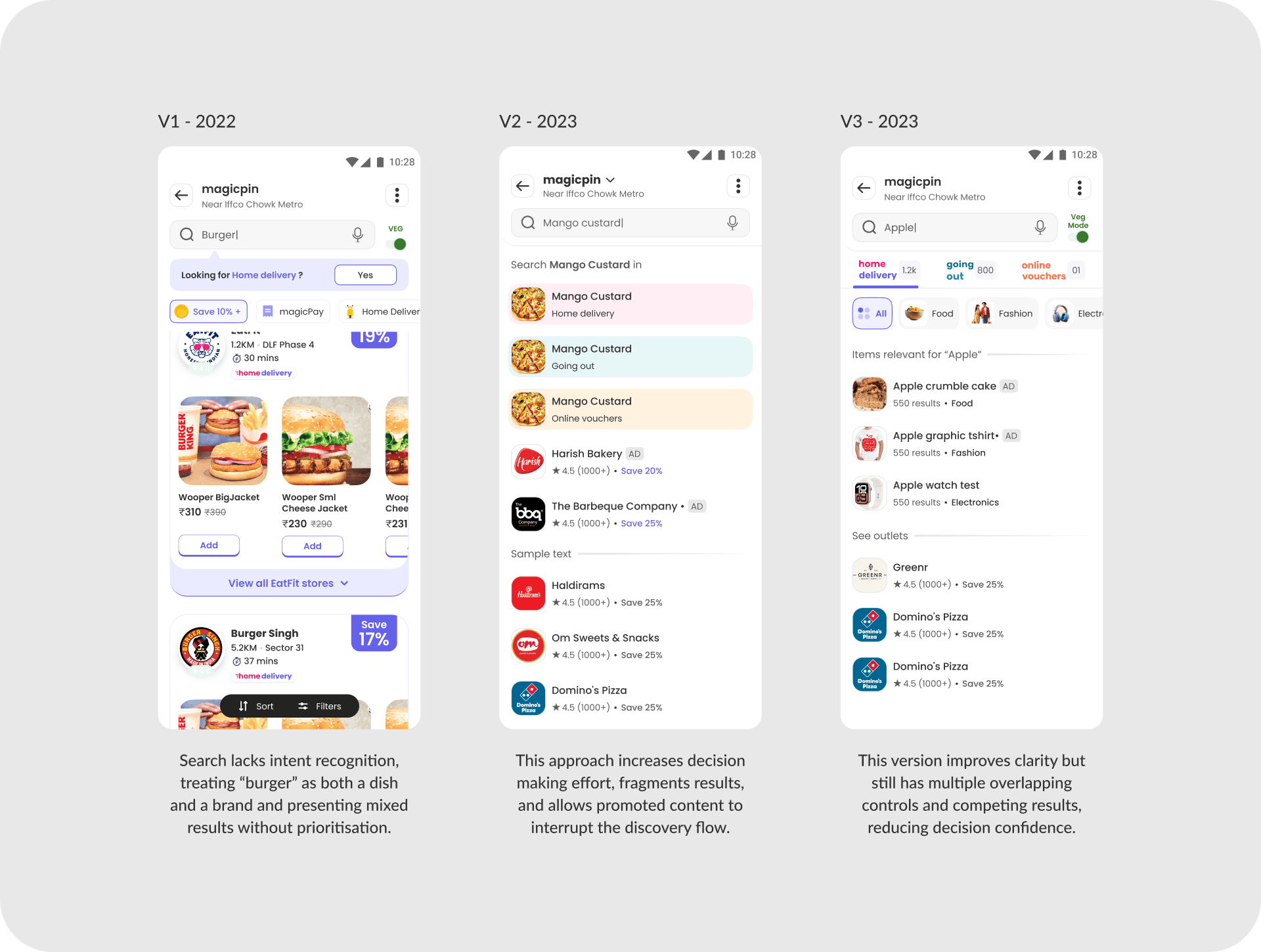
1. No clear entry point: There was no dedicated CTA which reduced visibility and led to low adoption.
2. Choice overload: Once inside the flow, all requests were shown together, creating decision fatigue
3. Missing context for occasional needs: There was no separate space for occasional or one-off requests
4. Lack of tracking & transparency: Users couldn’t see their request's progress
This will hide itself!
Magicpin is a multi-service ecosystem that serves a diverse set of user needs across food delivery, dining, vouchers, and shopping. Search is a critical entry point, but the existing experience was optimized for known-item queries rather than intent-driven discovery. This case study explores how we redesigned Magicpin’s search experience to prioritize user intent over raw queries, reduce cognitive load, and improve business outcomes through measurable, experiment-driven decisions.
Timeline
22 Days
Live On
Mobile App
🔍
Users get lost in multi-category offerings
Search results mix restaurants, dishes, brands, and offers in one list. Instead of helping users narrow down their intent, the experience asks them to mentally filter irrelevant options, increasing effort at the very moment they want clarity.
🧠
High cognitive load
Without prioritizing results based on user intent, search places unnecessary mental effort on users, delaying decisions and increasing confusion.
📉
Confusion leads to drop-off
When users are unsure which result matches their intent, they hesitate, tap back, or abandon the search altogether. This confusion disrupts discovery and directly impacts conversion.
📢
Promoted listings are ranked above relevant results.
Search prioritises funded results over the most relevant outcome, forcing users to scroll past unrelated or secondary options to reach what they are actually looking for.
Magicpin's POV
1. Improve Search-to-Conversion Rate 2. Reduce search abandonment 3. Enable Cross-Category Discovery 4. Balance Discovery with Revenue
User's POV
1. Search quickly without typing whole words 2. See relevant, trustworthy suggestions immediately 3. Explore options within a chosen category 4. Not switch to other apps to explore
1. No clear entry point: There was no dedicated CTA which reduced visibility and led to low adoption.
2. Choice overload: Once inside the flow, all requests were shown together, creating decision fatigue
3. Missing context for occasional needs: There was no separate space for occasional or one-off requests
4. Lack of tracking & transparency: Users couldn’t see their request's progress
This will hide itself!
Magicpin is a multi-service ecosystem that serves a diverse set of user needs across food delivery, dining, vouchers, and shopping. Search is a critical entry point, but the existing experience was optimized for known-item queries rather than intent-driven discovery. This case study explores how we redesigned Magicpin’s search experience to prioritize user intent over raw queries, reduce cognitive load, and improve business outcomes through measurable, experiment-driven decisions.
Timeline
22 Days
Live On
Mobile App
🔍
Users get lost in multi-category offerings
Search results mix restaurants, dishes, brands, and offers in one list. Instead of helping users narrow down their intent, the experience asks them to mentally filter irrelevant options, increasing effort at the very moment they want clarity.
🧠
High cognitive load
Without prioritizing results based on user intent, search places unnecessary mental effort on users, delaying decisions and increasing confusion.
📉
Confusion leads to drop-off
When users are unsure which result matches their intent, they hesitate, tap back, or abandon the search altogether. This confusion disrupts discovery and directly impacts conversion.
📢
Promoted listings are ranked above relevant results.
Search prioritises funded results over the most relevant outcome, forcing users to scroll past unrelated or secondary options to reach what they are actually looking for.
Magicpin's POV
1. Improve Search-to-Conversion Rate 2. Reduce search abandonment 3. Enable Cross-Category Discovery 4. Balance Discovery with Revenue
User's POV
1. Search quickly without typing whole words 2. See relevant, trustworthy suggestions immediately 3. Explore options within a chosen category 4. Not switch to other apps to explore
1. No clear entry point: There was no dedicated CTA which reduced visibility and led to low adoption.
2. Choice overload: Once inside the flow, all requests were shown together, creating decision fatigue
3. Missing context for occasional needs: There was no separate space for occasional or one-off requests
4. Lack of tracking & transparency: Users couldn’t see their request's progress
This will hide itself!